Since negotiations started in 2022, the plastic pollution treaty has become one of the key multilateral processes of our time. Governments, businesses and civil society have converged on the core elements of an effective and legally binding treaty that aims to end plastic pollution and transition to a circular economy. With INC-5.4 ahead, the question is whether the final text will match that ambition.
Our Economic Rationale Study, modelled in 2025 with Systemiq, compares two futures for the treaty. One has harmonised regulation for all parties on phase-outs and eliminations, product and system design, and extended producer responsibility. The other is a voluntary approach, where each party decides its own measures. The modelling covers Brazil, China, India, Indonesia, Japan and South Africa.
Harmonised regulation provides economic opportunities to business and is the lowest-cost and most effective route to lasting impact on plastic pollution.
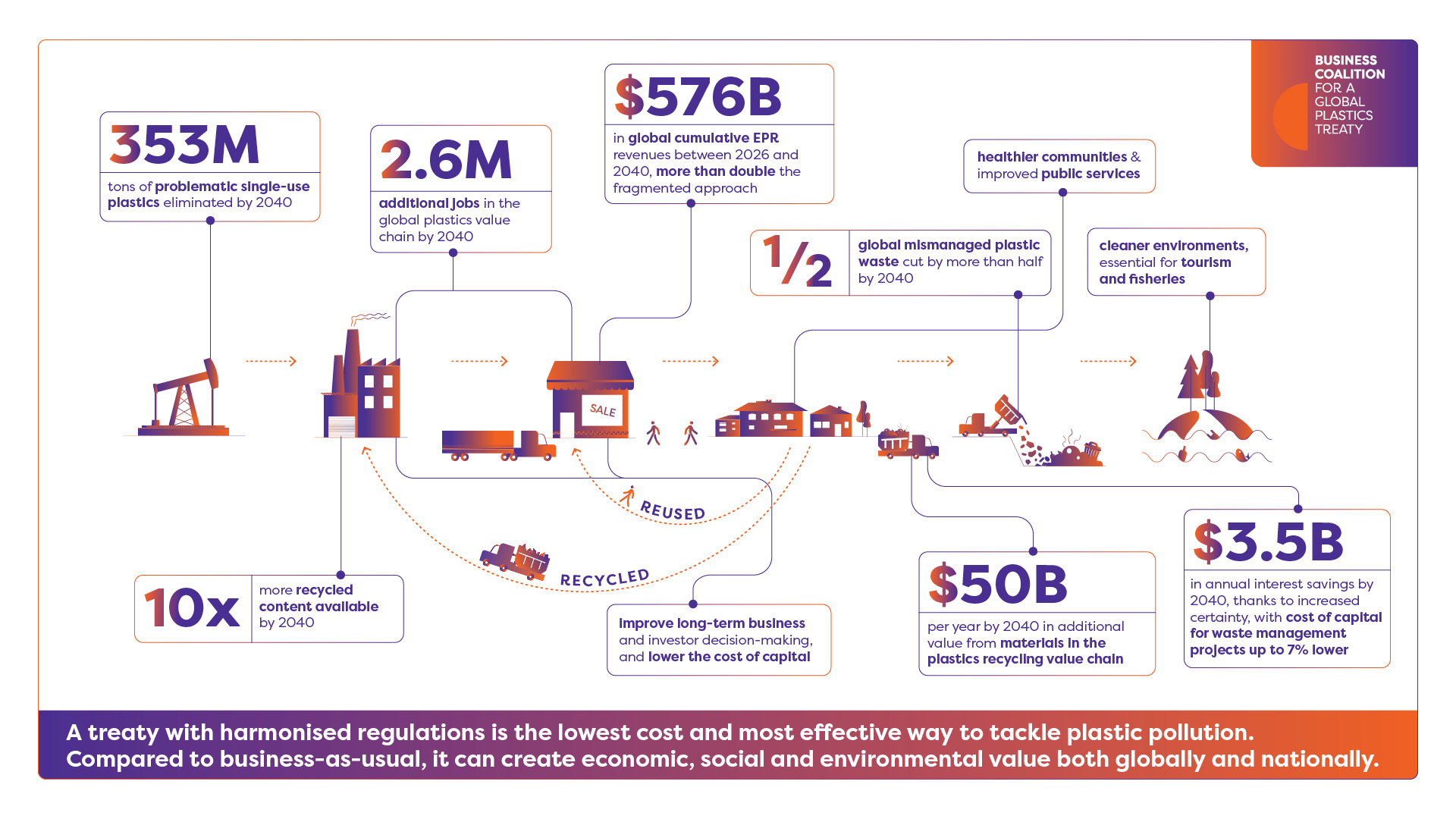
Compared with today's fragmented and voluntary regulatory patchwork, harmonised regulation would more than halve mismanaged plastic waste by 2040 and generate USD 576 billion in global cumulative EPR revenues to fund infrastructure where it is most needed. Importantly, this would not come at a cost to the job market, with harmonised regulations still adding 2.6 million jobs by 2040 across a growing value chain. Every year we wait, the cost compounds for our economies, our communities, and our environment.
Harmonised phase-outs could eliminate 353 million tonnes of single-use plastic items by 2040, preventing nearly 30 million fully-loaded garbage trucks from ever needing to be collected, transported and processed.
Well-designed EPR schemes can fund the infrastructure many countries urgently need. By setting common principles and minimum requirements across countries, the treaty could ensure end-of-life plastic is funded predictably and fairly, generating $576 billion in cumulative revenues between 2026 and 2040. That’s more than double the world's annual direct waste management expenditure.
Harmonised regulation gives businesses the certainty to invest, the consistency to innovate, and fair competition. It reduces the cost and complexity of operating under a patchwork of local regulations while creating a coherent operating environment with enough flexibility to support national ambitions.
It also lowers the cost of financing the infrastructure the treaty requires. Capital for projects in sectors with uncertain regulation carries a 3 to 7% premium over stable sectors like utilities or water treatment. Applied to the roughly $49 billion of annual investment needed by 2040 in waste collection, sorting, recycling and treatment, harmonised rules would save $1.5 to 3.5 billion a year in financing costs for the private investors, public bodies and public-private partnerships that build and run that infrastructure.
By 2040, economic activity across the plastics value chain is projected to grow 31% and employment 33%, adding 2.6 million jobs, equivalent to the entire UK manufacturing workforce.
Companies in markets with clearer rules are already advancing on recycling infrastructure and product design. Harmonised global regulation would extend that opportunity, opening access to new markets for both multinationals and SMEs.
Harmonised regulations on product design would bring significant positive impacts upstream. They could increase the availability of high-quality recycled content over tenfold, from 11 million tonnes in 2025 to 120 million tonnes by 2040.
Good design-for-recycling would make plastics cheaper to recycle, reducing the cost of collection by $90 to 140 per tonne and saving up to $50 billion a year.
As virgin plastic costs rise, recycling and alternative business models become increasingly competitive.
Halving mismanaged plastic waste by 2040 would ease pressure on natural systems, protect critical industries that depend on them such as tourism and fisheries, reduce reliance on virgin plastic, and lower the greenhouse-gas emissions linked to plastic production. These benefits strengthen the alignment between the Global Plastics Treaty and the climate, biodiversity and health commitments governments have already made.
A treaty with harmonised regulation is the lowest-cost and most effective way to help end plastic pollution. Continuing with the current approach would, by contrast, deliver only a fraction of this, at a far higher cost.
There is broad agreement across governments, businesses and civil society around the need for harmonised regulation on restrictions and phase-outs, product design, EPR and waste management, combined with a just transition and dedicated financial and technical support.
The Coalition's 330+ businesses, financial institutions and NGOs stand ready to work with policymakers to deliver an effective and legally binding treaty, and to support the national implementation that follows.
Every year of delay carries a significant compounding cost for our economies, our communities and our environment. There's no time to waste.
Since negotiations started in 2022, the plastic pollution treaty has become one of the key multilateral processes of our time. Governments, businesses and civil society have converged on the core elements of an effective and legally binding treaty that aims to end plastic pollution and transition to a circular economy. With INC-5.4 ahead, the question is whether the final text will match that ambition.
Our Economic Rationale Study, modelled in 2025 with Systemiq, compares two futures for the treaty. One has harmonised regulation for all parties on phase-outs and eliminations, product and system design, and extended producer responsibility. The other is a voluntary approach, where each party decides its own measures. The modelling covers Brazil, China, India, Indonesia, Japan and South Africa.
Harmonised regulation provides economic opportunities to business and is the lowest-cost and most effective route to lasting impact on plastic pollution.
Compared with today's fragmented and voluntary regulatory patchwork, harmonised regulation would more than halve mismanaged plastic waste by 2040 and generate USD 576 billion in global cumulative EPR revenues to fund infrastructure where it is most needed. Importantly, this would not come at a cost to the job market, with harmonised regulations still adding 2.6 million jobs by 2040 across a growing value chain. Every year we wait, the cost compounds for our economies, our communities, and our environment.
Harmonised phase-outs could eliminate 353 million tonnes of single-use plastic items by 2040, preventing nearly 30 million fully-loaded garbage trucks from ever needing to be collected, transported and processed.
Well-designed EPR schemes can fund the infrastructure many countries urgently need. By setting common principles and minimum requirements across countries, the treaty could ensure end-of-life plastic is funded predictably and fairly, generating $576 billion in cumulative revenues between 2026 and 2040. That’s more than double the world's annual direct waste management expenditure.
Harmonised regulation gives businesses the certainty to invest, the consistency to innovate, and fair competition. It reduces the cost and complexity of operating under a patchwork of local regulations while creating a coherent operating environment with enough flexibility to support national ambitions.
It also lowers the cost of financing the infrastructure the treaty requires. Capital for projects in sectors with uncertain regulation carries a 3 to 7% premium over stable sectors like utilities or water treatment. Applied to the roughly $49 billion of annual investment needed by 2040 in waste collection, sorting, recycling and treatment, harmonised rules would save $1.5 to 3.5 billion a year in financing costs for the private investors, public bodies and public-private partnerships that build and run that infrastructure.
By 2040, economic activity across the plastics value chain is projected to grow 31% and employment 33%, adding 2.6 million jobs, equivalent to the entire UK manufacturing workforce.
Companies in markets with clearer rules are already advancing on recycling infrastructure and product design. Harmonised global regulation would extend that opportunity, opening access to new markets for both multinationals and SMEs.
Harmonised regulations on product design would bring significant positive impacts upstream. They could increase the availability of high-quality recycled content over tenfold, from 11 million tonnes in 2025 to 120 million tonnes by 2040.
Good design-for-recycling would make plastics cheaper to recycle, reducing the cost of collection by $90 to 140 per tonne and saving up to $50 billion a year.
As virgin plastic costs rise, recycling and alternative business models become increasingly competitive.
Halving mismanaged plastic waste by 2040 would ease pressure on natural systems, protect critical industries that depend on them such as tourism and fisheries, reduce reliance on virgin plastic, and lower the greenhouse-gas emissions linked to plastic production. These benefits strengthen the alignment between the Global Plastics Treaty and the climate, biodiversity and health commitments governments have already made.
A treaty with harmonised regulation is the lowest-cost and most effective way to help end plastic pollution. Continuing with the current approach would, by contrast, deliver only a fraction of this, at a far higher cost.
There is broad agreement across governments, businesses and civil society around the need for harmonised regulation on restrictions and phase-outs, product design, EPR and waste management, combined with a just transition and dedicated financial and technical support.
The Coalition's 330+ businesses, financial institutions and NGOs stand ready to work with policymakers to deliver an effective and legally binding treaty, and to support the national implementation that follows.
Every year of delay carries a significant compounding cost for our economies, our communities and our environment. There's no time to waste.
Explore more: Our Treaty on a Page roadmap outlines five core obligations for governments to establish common rules across the full lifecycle, combined with COP mandates to strengthen these measures over time.
Explore more: Our Treaty on a Page roadmap outlines five core obligations for governments to establish common rules across the full lifecycle, combined with COP mandates to strengthen these measures over time.