
Despite challenges in the negotiation process, there is growing alignment and urgency to conclude an effective global plastics treaty to drive harmonised regulations to end plastic pollution. Within just a few years, we have seen significant progress. From plastics once absent from the global policy agenda, the process has advanced significantly since the 5/14 UNEA resolution to concrete proposals and draft texts at recent INCs. We are now closer than ever to coordinated global action on plastic pollution.
Robust interim discussions are now needed for countries to align on both the substance and the process necessary for these negotiations to be successful. While the growing convergence on key elements is an encouraging sign, negotiations must shift gears towards achieving alignment on a final agreement.
The environmental case is undeniable, and the economic case is equally clear: a treaty based on harmonised regulation is the lowest-cost and most effective way to pursue a lasting impact on plastic pollution. It would bring the clarity and consistency needed to significantly increase the recyclability and reusability of products across the world, expand the supply of high-quality recycled content while reducing its cost, de-risk investment for the necessary infrastructure and scaling of circular economy solutions. For businesses and investors, it would provide the much-needed certainty to improve long-term decision-making and lower the cost of capital, enabling them to catalyse investment and innovation towards long-term value creation.
These costs of inaction are too high, and compounding day by day, the business risk is too great, and the opportunity is too significant to miss. Many governments, businesses, and civil society organisations agree that a treaty with harmonised regulations across the entire value chain is needed to mobilise investment, scale solutions, and spark innovation.
The 300+ companies, financial institutions, and NGOs that are part of the Business Coalition for a Global Plastics Treaty support a treaty based on harmonised regulations that can deliver economic, environmental, and social value. Compared to a treaty based on voluntary national measures, a robust treaty with strong obligations and harmonised regulations on key elements – including restrictions and phase-outs, product design, and extended producer responsibility (EPR) – can drive consistency across borders with enough flexibility to support national ambitions.
There’s no time to waste. We stand ready to work with policymakers to turn momentum into harmonised, effective action to tackle plastic pollution around the world.
Despite challenges in the negotiation process, there is growing alignment and urgency to conclude an effective global plastics treaty to drive harmonised regulations to end plastic pollution. Within just a few years, we have seen significant progress. From plastics once absent from the global policy agenda, the process has advanced significantly since the 5/14 UNEA resolution to concrete proposals and draft texts at recent INCs. We are now closer than ever to coordinated global action on plastic pollution.
Robust interim discussions are now needed for countries to align on both the substance and the process necessary for these negotiations to be successful. While the growing convergence on key elements is an encouraging sign, negotiations must shift gears towards achieving alignment on a final agreement.
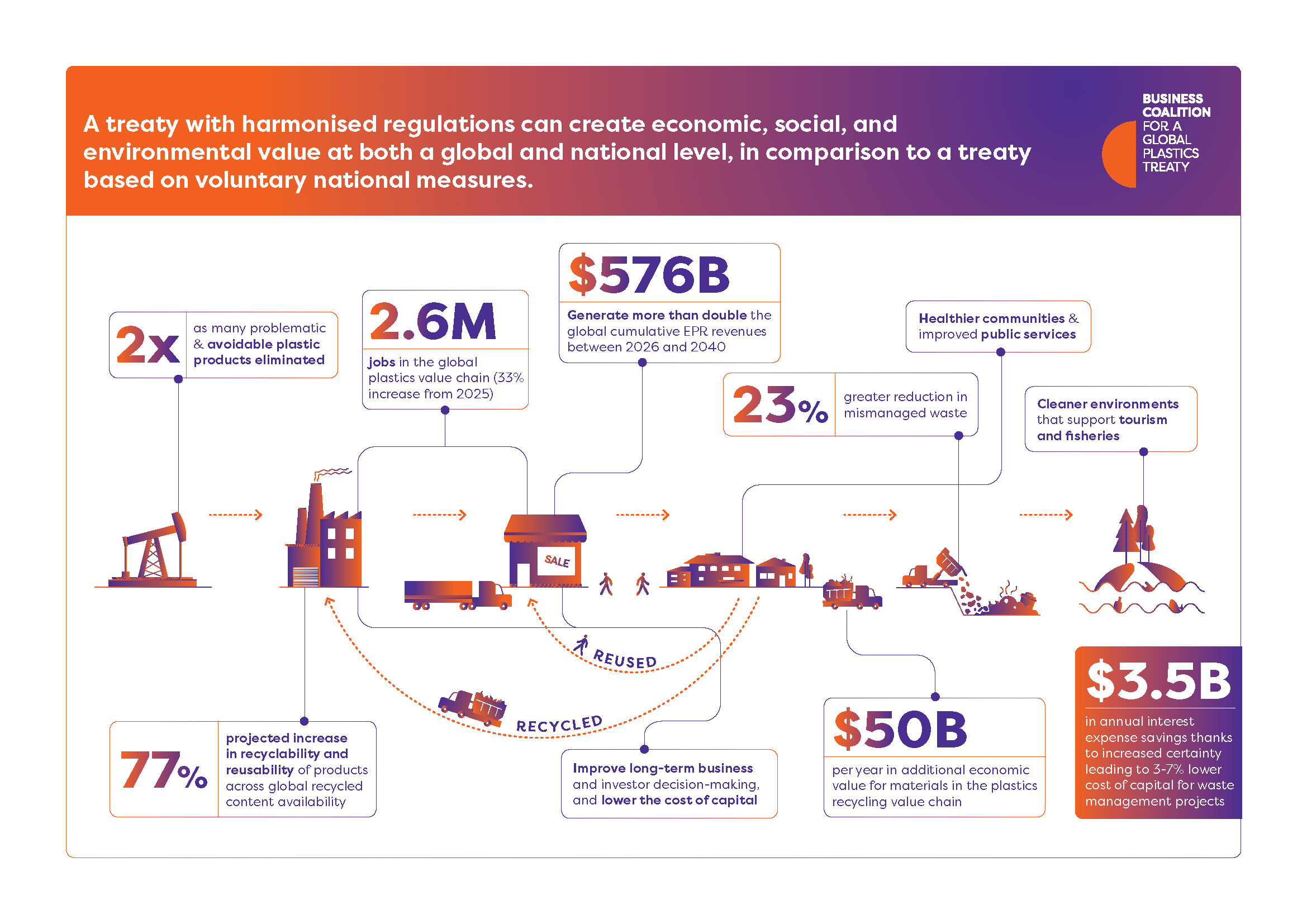
The environmental case is undeniable, and the economic case is equally clear: a treaty based on harmonised regulation is the lowest-cost and most effective way to pursue a lasting impact on plastic pollution. It would bring the clarity and consistency needed to significantly increase the recyclability and reusability of products across the world, expand the supply of high-quality recycled content while reducing its cost, de-risk investment for the necessary infrastructure and scaling of circular economy solutions. For businesses and investors, it would provide the much-needed certainty to improve long-term decision-making and lower the cost of capital, enabling them to catalyse investment and innovation towards long-term value creation.
These costs of inaction are too high, and compounding day by day, the business risk is too great, and the opportunity is too significant to miss. Many governments, businesses, and civil society organisations agree that a treaty with harmonised regulations across the entire value chain is needed to mobilise investment, scale solutions, and spark innovation.
The 300+ companies, financial institutions, and NGOs that are part of the Business Coalition for a Global Plastics Treaty support a treaty based on harmonised regulations that can deliver economic, environmental, and social value. Compared to a treaty based on voluntary national measures, a robust treaty with strong obligations and harmonised regulations on key elements – including restrictions and phase-outs, product design, and extended producer responsibility (EPR) – can drive consistency across borders with enough flexibility to support national ambitions.
There’s no time to waste. We stand ready to work with policymakers to turn momentum into harmonised, effective action to tackle plastic pollution around the world.
About the Coalition
The Business Coalition for a Global Plastics Treaty – convened by the Ellen MacArthur Foundation and WWF in September 2022 – gives voice to more than 300 businesses from across the plastics value chain, financial institutions and NGO partners.
Together we are asking for an ambitious UN treaty that brings plastics into a circular economy, stopping them becoming waste or pollution.
About the Coalition
The Business Coalition for a Global Plastics Treaty – convened by the Ellen MacArthur Foundation and WWF in September 2022 – gives voice to more than 300 businesses from across the plastics value chain, financial institutions and NGO partners.
Together we are asking for an ambitious UN treaty that brings plastics into a circular economy, stopping them becoming waste or pollution.